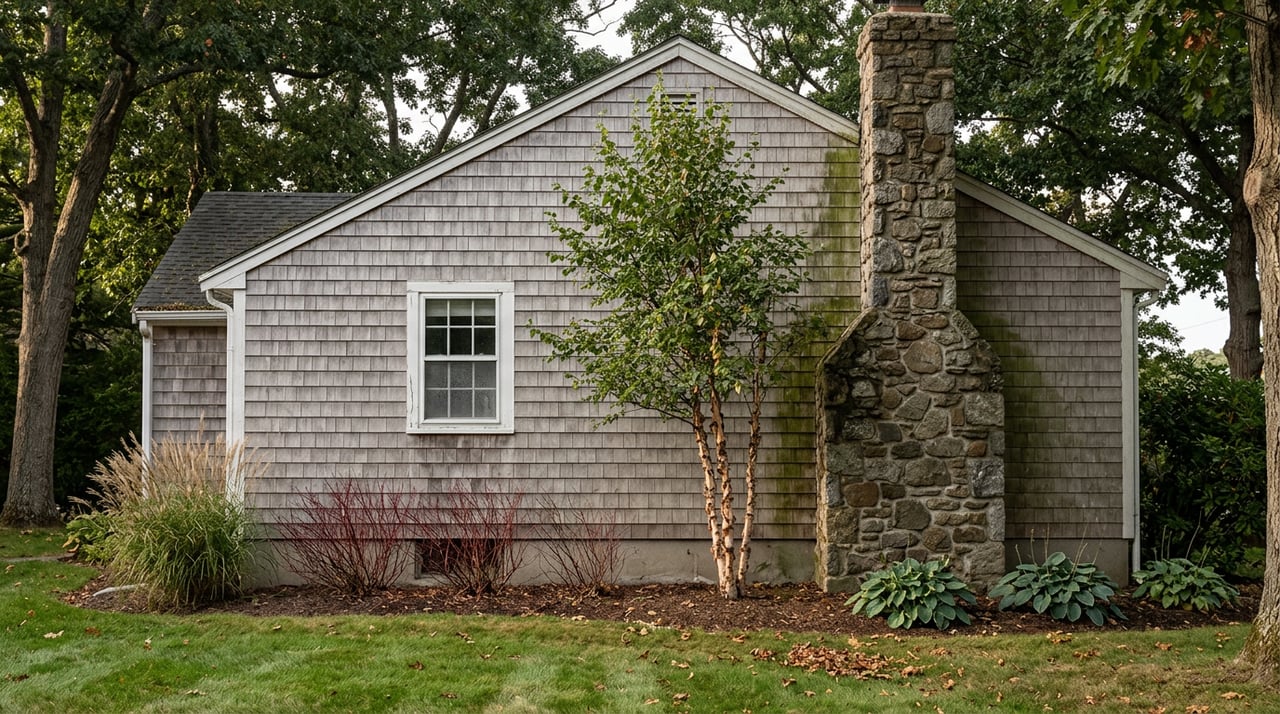
Say you tour a 1960s cottage on Big Cedar Lake. Low roofline, screened porch fifteen feet from the water, a pier that's clearly been rebuilt a few times. You picture what comes next: knock out a wall, push the primary suite toward the view, maybe add a second story down the road. The listing agent nods along. The seller mentions the neighbors did something similar a few years back.
None of that tells you what you're actually allowed to do, because the answer depends on a line you can't see standing on the dock. Big Cedar Lake's shoreline lies within the Towns of West Bend and Polk, both under Washington County's shoreland ordinance. For a buyer, the first question is which side of that town line contains the parcel.
The 75 feet everyone assumes, and the exceptions nobody explains
Wisconsin Administrative Code NR 115.05 sets a statewide minimum: new principal structures near a lake need to sit at least 75 feet back from the ordinary high water mark, the legal line that marks where the water's presence has shaped the land. Washington County adopted that standard for the unincorporated land around Big Cedar and Little Cedar Lakes. But 75 feet is a starting point, not a fixed wall. Where an existing pattern of development already exists on both neighboring lots, the county can average the setback down, and state code sets the floor for that average at 35 feet from the water. Wisconsin Statutes § 59.692 provides for an access and viewing corridor.
Height has its own ceiling near the water. Anything built within 75 feet of the ordinary high water mark is capped at 35 feet tall, a rule that's applied statewide since 2010.
Here's how the numbers stack up:
| Rule | What it actually allows |
|---|---|
| Standard shoreland setback | 75 feet from the ordinary high water mark |
| Setback with averaging (minimum floor) | Cannot go below 35 feet, even with neighboring precedent |
| Height limit near the water | 35 feet tall, for anything within 75 feet of the shoreline |
| Lifetime cap on lateral expansion of an older, closer-to-water home | Washington County Code § 275-7 limits it to 200 square feet over the structure’s life, and only if its existing footprint is at least 35 feet from the water |
That last row is the one that surprises buyers most.
The cottage you can't make bigger
A lot of Big Cedar and Little Cedar Lake homes went up before any of these setbacks existed. If a structure was legally built when it went in but sits closer to the water than today's line allows, it's what the code calls a legal nonconforming structure. You can maintain it, repair it, even rebuild it in place. What you generally can't do is grow it outward toward the lake in any meaningful way. State rule limits lateral expansion of a nonconforming principal structure to 200 square feet over the entire life of that structure, and only if the existing footprint is already at least 35 feet from the water. Once you've used that 200 square feet, whether this year or across three past owners, it's gone.
Vertical expansion is treated differently. A nonconforming structure can generally be built up, within the 35-foot height cap, without triggering the same footprint limit that governs building out. That distinction changes the math on a renovation: adding a second story might be realistic where pushing the walls toward the lake is not.
There's a second, quieter issue tied to lot size. Washington County's shoreland standards require unsewered lots to carry at least 20,000 square feet and 100 feet of frontage. Plenty of legacy cottage lots on these lakes were platted decades before that standard existed and are smaller than what today's code would require for a new build. That matters most when a septic system fails. Washington County's Land Use Division maintains a POWTS search tool specifically because private wastewater systems on older, undersized lots are a common flashpoint during a sale, and a failing septic system on a substandard lot can turn a simple replacement into a permitting conversation nobody budgeted time for.
A water view and the legal right to build toward it are two different things you're purchasing.
One lake, two towns under county rules
A detail worth checking before closing: Big Cedar Lake's shoreline sits inside two separate towns, the Town of West Bend and the Town of Polk, both of which fall under Washington County's shoreland ordinance. Confirm the parcel's municipality and applicable zoning office rather than relying on its mailing address.
Practically, a cottage's renovation potential can depend on its lot and the legal status of its existing structure, not just the appearance of a nearby property. Two properties across the channel from each other can have different constraints.
None of this is a knock on how well the lake is managed. The Big Cedar Lake Protection & Rehabilitation District, established in 1994, exists specifically to steward water quality across that jurisdictional patchwork, and the Cedar Lakes Conservation Foundation has been active on the ground recently, too. In partnership with Washington County conservation staff, the foundation completed three berms on a 32-acre property near the lake in late 2025, designed to slow stormwater and sediment runoff before it reaches the water. The lake is a genuinely well-tended shared resource. The shoreland rules governing what you can build are a separate question from the lake's stewardship.
What the listings hint at
Ask for Big Cedar Lake waterfront data and you'll get a different answer depending on how the search is scoped, and the differences are wide enough to be the story on their own. Filtered broadly, active Big Cedar Lake waterfront listings this summer average around $801 per square foot with homes moving in roughly three weeks. Filtered to just the county-wide waterfront segment as of April 2026, the picture flips: a median listing price near $1.9 million and an average of 237 days on market, the profile of a buyer's market rather than a seller's one. Filtered again to listings using a West Bend address, as of early August 2026, the average climbs above $2 million while the typical time on market drops to around 61 days, a seller's market by the same measure.
Three searches for the same lake, three different markets. Some of that comes down to how few properties trade on this lake in any given window, which makes averages swing hard on a single sale. The zoning-related constraints and renovation options can also vary by property, so buyers should assess the specific parcel rather than treat these figures as a uniform market. These are active listing figures, not closed sales, so treat them as a read on current asking behavior rather than a verified sale-price trend.
What to check before you assume anything
If a Big Cedar Lake or Little Cedar Lake cottage is on your list, a few questions are worth settling before you write an offer that assumes a future addition:
- Confirm which town the parcel sits in using the county's GIS parcel lookup rather than the mailing address
- Ask whether the principal structure is classified as legal nonconforming, and if so, whether any of that 200-square-foot lifetime allowance has already been used by a prior owner
- Check the age and permit history of the septic system against the lot's size, especially on anything platted before the current 20,000-square-foot unsewered standard
- Get any setback-averaging calculation in writing from the relevant zoning office before pricing a rebuild into your plans
- Bring the local Land Use Division into the conversation early, before any inspection contingency is waived
Lake Country living has always been about more than the view from the pier. For Big Cedar Lake properties, it's also about knowing how the county's shoreland rules apply to the specific parcel. That's the kind of local groundwork Kimberly Stark walks buyers through before an offer goes in, not after. If a Big Cedar Lake or Little Cedar Lake property has your attention, schedule a free consultation and get the jurisdiction question answered before it becomes a surprise.
This article is general information, not legal, tax or financial advice. Consult a qualified professional about your situation.